

The title of this post is a quote from Jacques Lacan, the French psychoanalyst. The quote is one I’ve always liked and felt was true. It comes from a lecture Lacan gave in 1954 or 1955, in which he argued that the development of the ego, or “I,” emerges as the child sees itself reflected in the world. Reflections come not just from literal mirrors, but from all sorts of things that behave like mirrors: our parents’ reactions to us, the culture surrounding us, the words spoken to us, and the reactions, both verbal and non-verbal, of strangers. Thus, the “I” isn’t some true “identity” with some deep “core”—it is a pixelated mosaic of all these reflections that we struggle to name.
Social science is much like Lacan’s mirrors: we try to name things in the world, never through direct observation, but in the reflections of little mirrors. Sometimes the mirrors reflect the phenomenon we meant to study. Sometimes they reflect us instead.
So what does this have to do with “slop?”
Over the last few months, I worked on the Organization Science Artificial Intelligence Task Force with Claudine Gartenberg, Lamar Pierce (the Editor-in-Chief of Organization Science), and Alex Murray. Honestly, going into this exercise, we didn’t know what we would find. But we knew that our guiding principle was to never stop asking the next question.
Here is a short list of things we found. In essence, the journal is inundated with slop, and it’s causing a lot of stress. You should read the full paper (“More Versus Better: Artificial Intelligence, Incentives, and the Emerging Crisis in Peer Review”) and the write-up on So, Here’s the Idea, the official Substack of Organization Science.
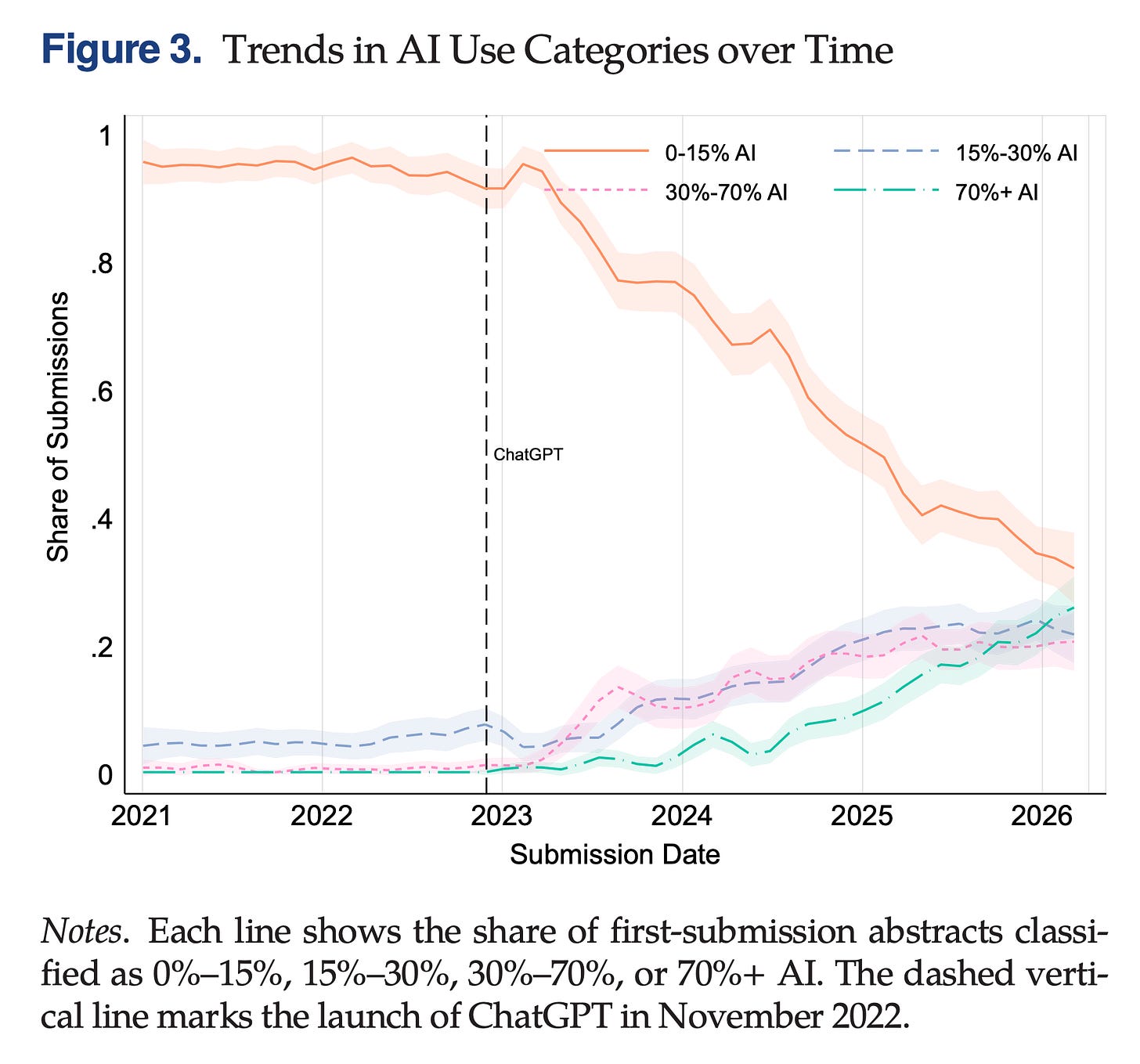
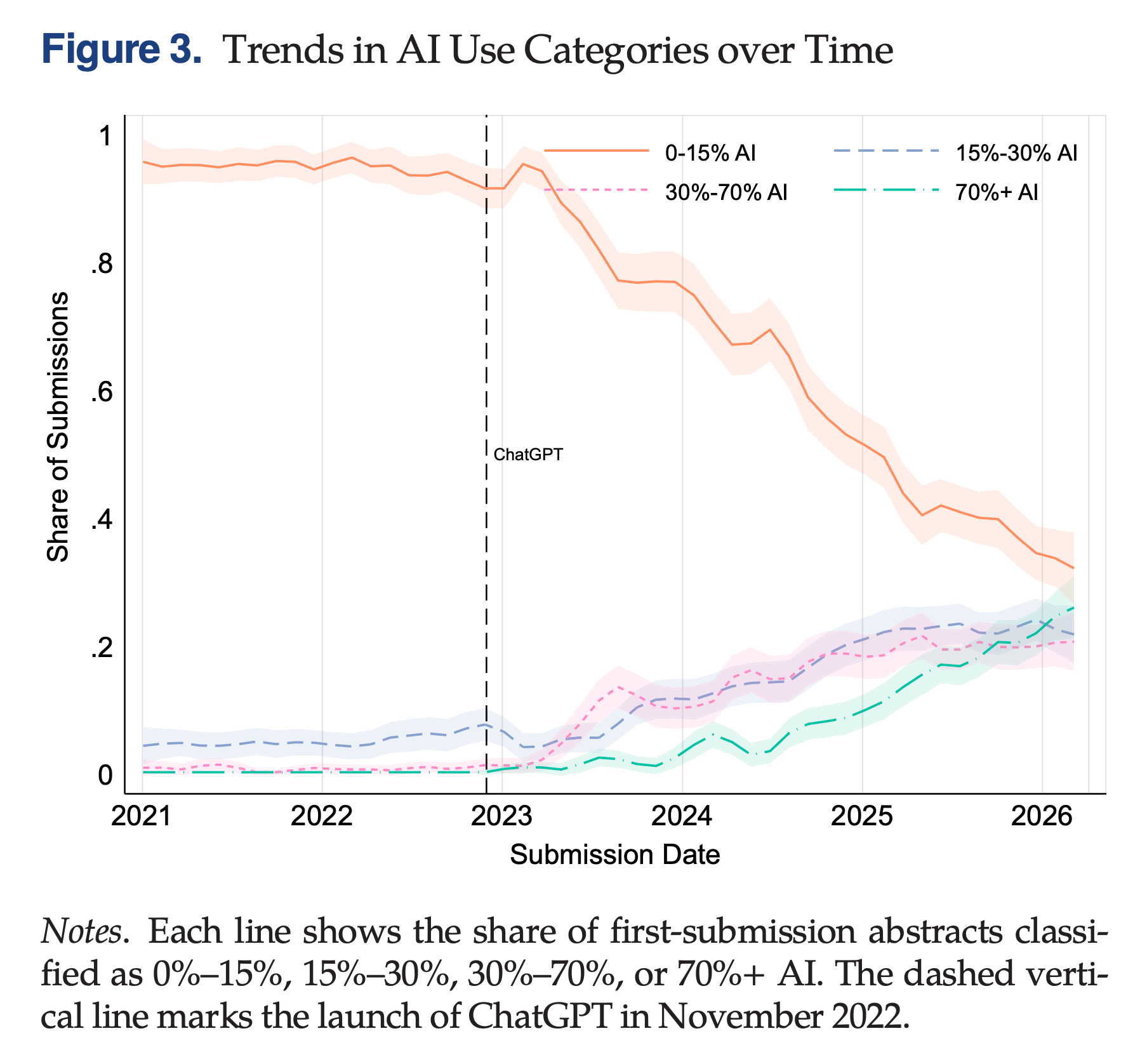
First, the recent rise in journal submissions (a 42% increase in monthly submissions and rising, after ChatGPT’s launch) is primarily due to AI use, not organic growth in the field or increased journal reputation. AI-assisted manuscripts are now the majority of submissions.
Second, while many believe that AI improves writing quality, we show that AI has led to a deterioration of prose in submitted manuscripts and reviews.
Third, we show that the authors most likely to use AI in writing—research teams from non-native English-speaking institutions and new entrants to the field—do not benefit in the review process and, in fact, may be harmed when using AI for writing.
Fourth, while prior research suggests a strong overlap between AI and human reviews, we show that AI reviews are much narrower than human ones.
Finally, and perhaps most importantly, celebrating AI as a productivity-generating technology misses its collision with the field’s incentive structures. When institutional incentives push “pubs” over rigorous research, AI will be used to drive volume rather than to fulfill its potential as a critical research technology.
While you should read the official report, you didn’t really need to read it to understand why we are in this situation. You just need to spend an afternoon with a professor up for promotion or browse online career forums.
Rarely do people talk about who wrote great research or what the exciting ideas are.
The most common questions ask about tenure requirements in cryptic shorthand: “3As,” “4-5 As,” “reasonable pubs.” Then decoding ensues: what does an “A” refer to (UTD, FT50, ABDC; do entrepreneurship journals count, or is there some unstated hierarchy among these that isn’t expressed?) Is this 4-5 As in print, or accepted? Do conditional accepts count? What about As before joining? Citations? How many?
AMJ, AMR, AJS, ASR, ASQ — then JAP, MS, OS, JPSP. Does OBHDP count?
Acceptance rates are so low. 2%, 3%, or 5%. The mathematics isn’t friendly. It’s mostly just rejection.
Even when schools provide written numerical targets, qualifiers always come up late in the process: some listed journals don’t “really” count—too “low brow”, the papers have to be solo-authored, or at least first-authored, but just “empirical” work won’t count, it has to be “theoretical.” What is “theoretical” anyway?
Some scholars talk about how standards shift midstream. You were told X was the magic number. But after mid-tenure review, it’s really, actually X+2, you know. Too late.
Even schools in the same tier have divergent expectations. Some just count. Others require “pubs” on a “list.” Others say that the majority of cases are “marginal.” With highly subjective criteria putting the thumb on the scale either way.
Maybe if we just crowdsourced tenure requirements and journal classifications, we can uncover the “platonic” list: the one true list that governs them all. So let’s create a comparison chart that maps which schools count what journals, and whether “three reasonable pubs” means UTD outlets or just peer-reviewed ones. What does “balanced” versus “research-intensive” mean again?
Maybe counting isn’t a discrete thing. Journals might be tiered, so you might get full points for some, partial credit for others, and even a big fat “0” for others—even if the idea is great. Actually, never mind, negative points. You shouldn’t have wasted your time on this.
Who writes that many papers? Need to collaborate. Does first authorship on a second-tier journal outweigh second authorship on a top journal? It’s alphabetical. My name is last. How many solo-authored papers do I need?
Should I add a senior author’s name to add credibility? Will the credibility be offset by the loss of credit?
Scholars talk about tracking other candidates’ productivity. “They already have 2 UTDs and an R&R at an A-?” I’m getting rejected. I’ll check their Google Scholar page. 120 citations? What’s mine? 17? Refresh. Refresh. Refresh. The same. At least it isn’t going down. Wait, what? Did it really?
Someone posted their new paper. Lots of people are liking it and retweeting it. I probably should post more on X. It's a cesspool. Maybe LinkedIn? It’s all AI these days. Humbled and honored.
Can I move up? I’m at a balanced school. How many UTD pubs do R1s want? Does an R&R count? I know I’ll never end up at an “Uber-Snobby” school, but maybe an R1? What are R1s anyway? Is this school on the TAMUGA rankings?
The spreadsheet is also a panopticon of professional comparison, especially for young researchers on the job market. What schools sent out interviews? Have offers been made? How much was the package for an R1 school? Does a 3-0 teaching load with a $5k research budget outweigh a 2-2 with a $10k?
How do you decide what should be in your pipeline? What are the journals looking for? If a paper can be placed only in “B-tier” journals, is it worth pursuing? Maybe after tenure.
Should I pivot to AI research? Everyone else is working on it. Do I become irrelevant if I don’t?
Best timing? Before the conference or after? Summer break? Winter break? Thanksgiving? If a paper is accepted shortly before the job market, should you present it as ‘forthcoming’ or save it as your job market paper?”
Candidates for faculty jobs talk about exploding offers. Impossible decisions: accept before hearing from preferred schools, or decline and risk having no offer at all. Game theory, but with life-altering stakes. Let us know by the end of the week.
Junior scholars talk about having to review multiple papers a month. How do I get on the editorial board? Do I need it to get tenure?
More papers are coming in. More reviews. More reports. More reading. Is there any time to do your own research? Will reviewing help me publish there? Reminder. You’re two weeks overdue. Three weeks overdue.
Even editors are not immune. A paper sent to a journal to “get feedback” goes to an editor handling 250 papers a year. Desk reject. Short note. It’s the paper, not you. Please consider submitting again. You got mail. Subject: Why did you reject my paper? Without reviews? I worked so hard on it. At least give me some feedback.
A junior researcher asks: ‘Am I becoming irrelevant?’ Citation counts are stagnating, and colleagues are publishing in more prestigious outlets. Research trends have shifted. Is my expertise off-trend?
Journals require AI disclosure in ways that seem impossible to comply with honestly. What counts as ‘AI assistance’ in an environment saturated with AI-generated text?
The spreadsheet—tabs for ‘Rejections,’ ‘Who Went Where,’ ‘Comparing School Types,’ ‘Salary Info,’ ‘Interview Questions,’ and ‘Candidate Lists’ and detailed journal ranking matrices across dozens of institutions—“Catharsis.”
Refresh.
Overworked uncompensated reviewers and editors. I know it has unappealing equity implications, but charging authors to submit would make the cost of slop higher. Costs go up, supply go down. Paid reviews increase the supply and timeliness of reviewers. We subsidize fees from disadvantaged groups. Markets are unpopular these days, but they are powerful allocation machines.
The mirror framing concedes too much to AI. The old incentives rewarded volume, but gaming them still required a costly act — writing the words yourself. That cost was the minimal institutional proof that someone was present. AI removes the cost. The incentive stays.